Static or dynamic QR codes: what you are really choosing
Will the pattern change, can the link be updated, where do the numbers come from? One visit path that separates the three questions people mix up most.

Key takeaways
- Neither printed pattern changes on its own; the difference is what it encodes and how the visit travels afterwards.
- The page behind a static link can be updated, but the address inside the pattern cannot be rewritten.
- A dynamic code’s flexibility comes from a redirect service that keeps running, so confirm who maintains it before publishing.
When people make a QR code, “static” and “dynamic” are often read as “simple” and “advanced”. What actually decides how it works is not the label but two questions: will you need to change the destination after the material is published, and are you willing to maintain the redirect service in between? A fixed contact record does not necessarily need a dynamic code, and long-lived product packaging is not necessarily the right place to encode a temporary campaign address.
This article does not judge by plan price; it follows the path a scan takes and explains how to choose from your own requirements.
01 Separate the pattern, the address and the page content
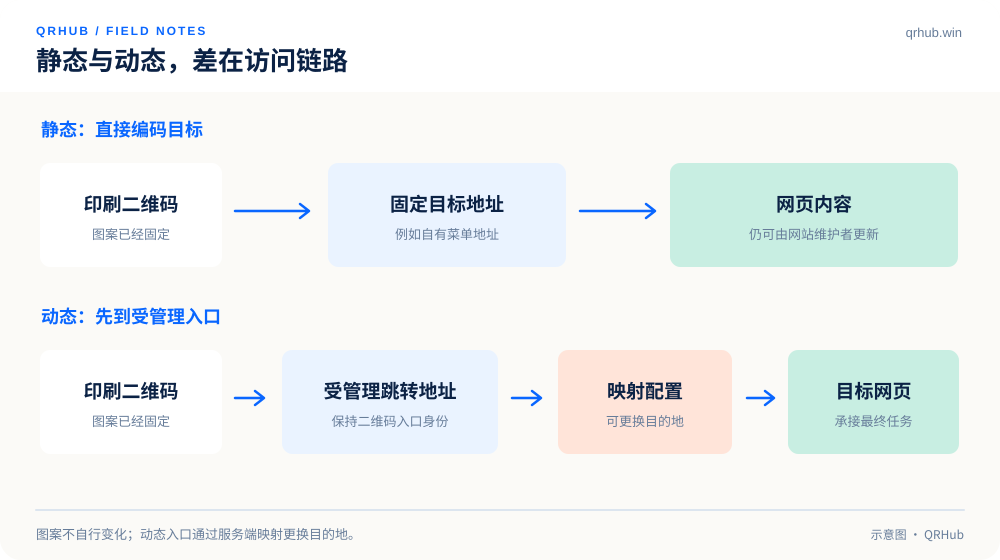
A static code encodes the target content directly, a full web address for example. A dynamic code usually encodes a redirect address managed by a platform, and a server then routes the visit to whatever destination is currently configured. Once either code is printed, the pattern does not change on its own; “dynamic” means the mapping in the middle can be updated.[1]
So “a static code cannot be updated” needs to be stated more precisely. If a static code always points at a menu URL you control, you are entirely free to change the dishes and photos on that page. What cannot be rewritten is the URL inside the printed pattern, not the page itself. Conversely, a dynamic code will not maintain the destination site’s content for you either.
02 When a static code is enough
If the content is stable, the destination is under your control and you do not need per-code management at the platform level, a static code is usually enough. A brand site on a business card, a fixed introduction page on a display board, a short piece of text shared offline: its directness means one less third-party redirect to depend on.
But one layer less to depend on does not mean it stays valid forever. Letting the domain lapse, deleting the page or revoking file permissions all break the experience after a scan. Choosing a static code still means somebody has to own the destination page. While you make it, also ask whether that address might be replaced because of a campaign redesign, a file rename or a reorganization.
03 When a dynamic entry point earns its place
When the same piece of material stays in a store, on product packaging or in trade-show handouts for a long time while the destination may switch, a dynamic entry point is easier to manage. Today it leads to a set of instructions; later it can be moved to a new help center while the printed pattern stays exactly as it is. An HTTP redirect is itself a mechanism for sending a visit to another address, and its stability and caching behavior depend on the server being configured correctly.[2]
A dynamic entry point can also give visit logs somewhere to collect, but “requests can be recorded” is not the same as “people have been identified accurately”. Automated previews, repeat opens, filtering rules and privacy settings all affect how the numbers should be read. Do not promise that every scan is tracked to one real person merely because you used a dynamic code.
| Decision question | Leans static | Leans dynamic |
|---|---|---|
| Will the destination change after publication? | Rarely, or you have a stable address of your own | It switches often and the material is awkward to reprint |
| Do you need to pause codes and change where each one leads? | No | Yes, managed centrally |
| Are you willing to maintain a redirect service? | You would rather depend less on a platform | Someone owns the service and its configuration |
| Do you have to know how each individual code performs? | Destination page analytics are enough | You need a clear per-code identity and agreed measurement rules |
04 Put the choice into the whole lifecycle
Take an example cafe: the menu content changes every week but always lives at the same address you own. A static code pointing there may already meet the need. If several stores need to switch destinations temporarily, retire a wrong link centrally and see how each location performs, then a managed dynamic entry point is worth adding.
This is not about one option being inherently better; it is about where control sits. When you control the destination site, stable pages let you replace codes less often; when you manage many destinations across departments, a managed entry point reduces maintenance chaos. Writing the address, the owner, the purpose and the end-of-life plan into a list before publication works better than hunting down the original author afterwards.

05 Four questions to settle before publishing
First, what will a scanner see if the service fails? A paused page with an explanation is easier to understand than a blank one. Second, can the maintainer view and correct the destination? Third, once the material is retired, will historical numbers be kept, an archived notice be shown, or the redirect simply stop? Settle these before publishing rather than after the campaign ends.
Finally, check the actual terms of service for validity periods, limits, domains and data retention rules. Do not infer that a platform service lasts forever from the fact that a QR code image can be saved, and do not read another vendor’s rules into your own account. These belong to a specific product agreement; this article makes no commitment on behalf of any plan.
06 Decide with a real use case
Run a small experiment for your own use: generate both kinds of test code, write down what each one encodes, simulate a change of destination, then visit again with a phone. Watch which layer actually changed. Deciding what the real material uses after that experiment is more reliable than reading feature labels.
Whichever you pick, keep a clear prompt next to the code, a fallback way to reach the same place, and a named maintainer. What people actually notice is whether they reach the right page, not which category of QR code carried them there.
Sources and further reading
- QR.io, how dynamic and static QR codes differ. A general mechanism reference only; it does not represent a QRHub plan commitment. https://qr.io/
- MDN, Redirections in HTTP. https://developer.mozilla.org/en-US/docs/Web/HTTP/Guides/Redirections
Related reading